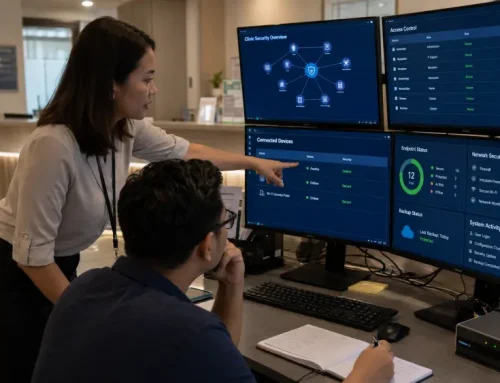

A business firewall can appear to be working while important risks remain out of sight. Employees may still access the internet and cloud applications even when administrator access is unclear, remote logins rely only on passwords, old rules remain active, alerts go unanswered or the device no longer receives the protection the business expects.
These warning signs do not prove that a breach has occurred. They do mean the business may be relying on a critical security control that nobody can confidently verify. If the gaps are left unresolved, the consequences can include unauthorised changes, preventable service disruption, slower incident detection, longer investigations, lost staff productivity and rushed technology spending when something eventually fails.
Business leaders do not need to know how to configure a firewall. They do need clear answers about who controls it, how access is protected, whether it remains supported and who takes action when something suspicious happens.
The signs that your business firewall needs a review are not always visible to management. If the responsible team cannot provide accountable answers, the issue should not remain on an indefinite IT to-do list. It warrants a structured assessment before uncertainty becomes a larger security, operational or financial problem.
Table of Contents:
Which Firewall Warning Signs Need Attention First?
Not every warning sign carries the same level of concern. As a practical management guide, the issues below can be grouped by how quickly they deserve attention. This is not a formal security severity rating, and the final priority should be confirmed by a qualified network-security professional.
| Priority | Warning Signs | Possible Business Impact |
|---|---|---|
| Higher urgency | Remote or administrative access depends only on passwords; the firewall login page may be inadequately protected from public access; the device is unsupported and may no longer receive vendor security fixes. | Greater risk of unauthorised access or configuration changes, exposure to unresolved security weaknesses and service disruption. |
| Review soon | Administrator ownership is unclear; old firewall rules have no clear owner; logs or alerts exist but nobody clearly owns the response. | Reduced accountability, unnecessary access remaining open, and slower detection or investigation. |
| Operational investigation | Required security services cause unacceptable slowdowns, connection failures or capacity problems. | Disrupted cloud applications, failed connections, slower workflows and lost staff productivity. |
If there are signs of unauthorised logins, unexpected configuration changes or active compromise, treat the situation as a security incident rather than waiting for a routine firewall assessment.
What a Business Firewall Does
A business firewall controls network traffic between systems or networks with different security requirements. Depending on the solution, it may also support secure remote access, traffic inspection and other protective controls. NIST SP 800-41 Rev. 1 provides foundational guidance on firewall policy, configuration, deployment and ongoing management. It is useful as foundational guidance, not as current threat intelligence.
A network firewall for business use therefore needs to support both the organisation’s security requirements and the way employees, applications and locations actually connect.
For a Malaysian SME, the firewall is more than the device providing internet access. It forms part of the security boundary between the internal environment and other networks. QubeApps also discusses broader business IT priorities for Malaysian SMEs for organisations reviewing their overall technology environment.
It is also only one layer of business network security. Endpoint protection, identity controls, backups, user awareness and monitoring remain important separately. Firewall requirements can also change as the organisation adds cloud services, remote users, branches or new applications.
Seven Warning Signs to Discuss With Your IT Team
What Should a Proper Firewall Assessment Clarify?
A useful assessment should give management clearer answers, not simply produce a long technical report. It should establish:
- who administers the firewall and how privileged access is controlled;
- how remote and management access is protected;
- whether important rules still have a valid business purpose;
- whether logging, alerting and response ownership are working;
- whether the firewall model, firmware and required services remain supported;
- whether the current setup can handle realistic traffic and security requirements.
The findings should explain which issues relate to access, configuration, monitoring, lifecycle or capacity. Possible next steps may include tightening access, removing outdated rules, improving alert ownership, updating software, renewing required services, adjusting configuration, increasing capacity or planning a replacement. The correct action depends on the cause.
What Should Management Receive From the Process?
For business owners, directors and finance or procurement approvers, the value of the process is clarity. Management should understand:
- 1
What needs attention
- 2
Why it matters
- 3
Which items deserve priority
- 4
What type of action is recommended
That gives decision-makers better context before approving a firewall renewal, upgrade or replacement. It also reduces the risk of making a hardware purchasing decision when the actual problem may involve access control, configuration, monitoring or lifecycle management.
How QubeApps Can Support the Next Step

For organisations comparing business firewall solutions in Malaysia, the right choice goes beyond the product itself. The solution should match the organisation’s access requirements, security priorities, support expectations and network environment.
QubeApps Cybersecurity Solutions cover relevant areas including next-generation firewalls, secure access controls, MFA, role-based access control, centralised logging, threat detection, monitoring and external firewall protection. QubeApps also follows an Assess, Design, Implement and Monitor approach across its cybersecurity offering.
If several of the management questions in this guide apply to your business, QubeApps can help you clarify which areas of your current environment may need further attention. For broader context, see our guide to cybersecurity risks for Malaysian SMEs.
Contact QubeApps to discuss the right next step for your business firewall and cybersecurity environment.