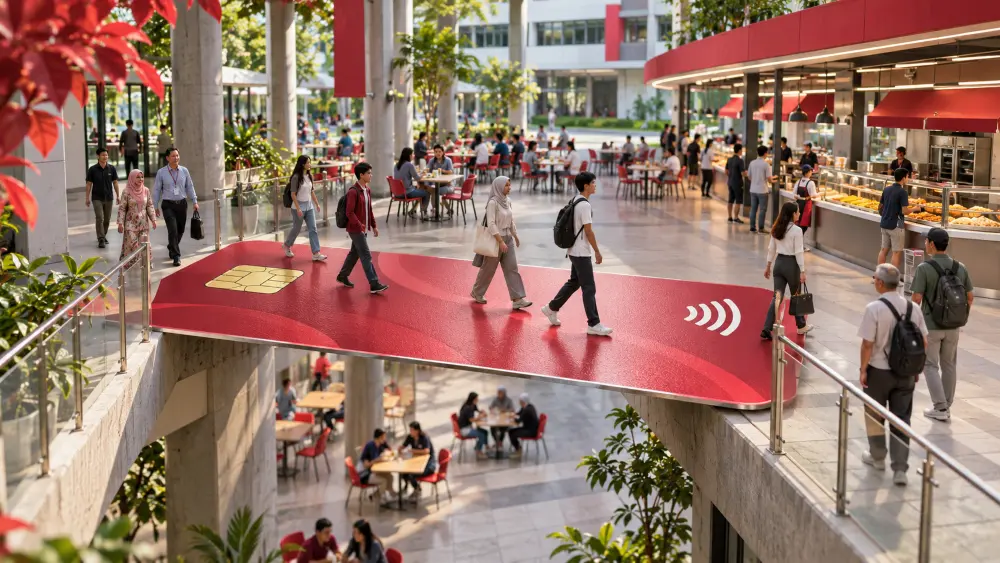
Buying lunch without carrying cash is familiar to many Malaysians. Bank Negara Malaysia’s 2025 annual report puts the average at 538 electronic payments per person, up from 432 in 2024. For colleges, that raises a practical question. Can someone who is visiting for the day pay for lunch as easily as someone who studies or works there?
At the counter, a cashless payment saves the cashier from counting change and gives the stall a record to check if a diner asks about a charge later. But the payment method has to work for the people in the queue. A student might pay with a campus card they use every day, while a parent visiting for an open day might have only a debit card or a banking app.
This guide is for Malaysian college and university teams planning a cashless campus canteen. It explains how one lunch purchase is recorded, how to choose payment options for regular diners and visitors, and what the finance team needs to check that the stall was paid.
How does a cashless canteen work?
At the stall, the cashier enters the meal and its price. The diner taps a card or scans a QR code, and the cashier checks that the payment went through before handing over the food. A canteen management system keeps the sale record, including what the stall sold and for how much. If the cashier takes payment on a separate terminal or through a separate app, the confirmation may show up there. The finance team needs to know where both records are kept so it can check whether the stall was paid for what it sold.
Some colleges let students and staff add money in advance to a college payment account called a campus account. They can then tap their campus card at a stall that accepts it, and the cost of the meal comes out of their canteen balance.
Key Takeaways
- Choose a payment method visitors can use without a campus account, and make clear which stalls accept it before diners queue.
- Before launch, ask someone to buy lunch as a visitor at two stalls. See whether they can tell how to pay before they order.
- Have a stall show finance where to find both the meal sale and its payment. Ask to see how a refund appears in those records.
- If a stall loses its internet connection during lunch, staff should know what they can still accept and how to record those sales.
Table of Contents:
Do students and staff need a campus card to pay?
Students and staff can pay the same way as visitors if the stall accepts a method all three groups already use. For example, a college could start with debit cards if its regular diners have cards that the stalls can accept. Check that with students and staff before choosing what to offer.
If regular diners already rely on campus card payments, keep that option and give visitors a way to pay with their own card or app. This lets a student spend money they’ve already added to their canteen balance while a visitor buys the same meal without signing up with the college.
How can visitors pay at a campus canteen?
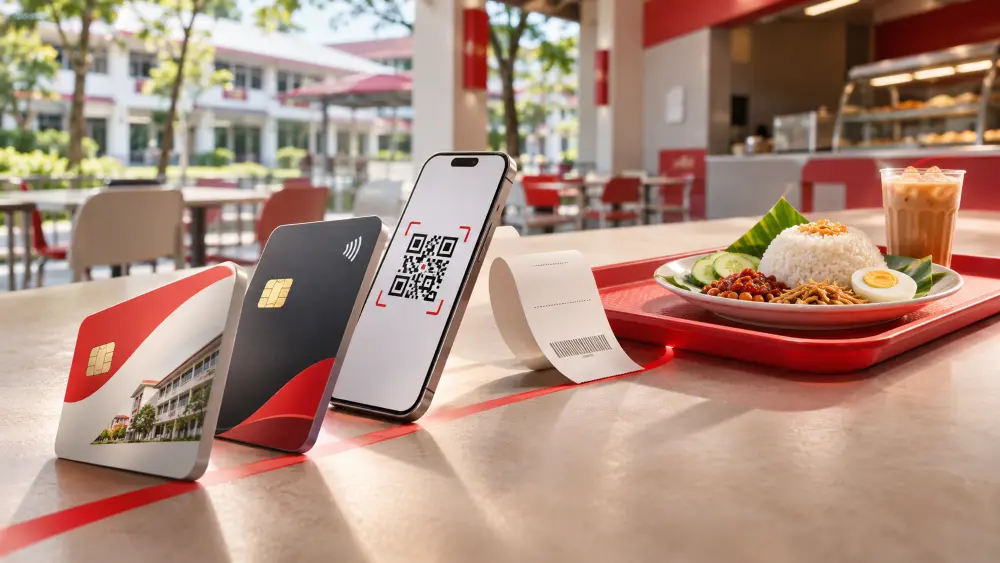
At stalls that get a lot of visitors, such as those near an event hall, offer a way to pay without a campus card. That might be a debit or credit card. For QR payments at the canteen, a visitor can scan the stall’s DuitNow QR code with a participating bank or e-wallet app.
If payment options vary by stall, list what each stall accepts on its menu board. A visitor with only a debit card can then see where to queue.
How can finance check that each meal was paid for?
Say a student and a visitor each buy an RM8 meal from the same stall. The student starts with RM20 in their canteen balance. After they tap their card to pay, the stall records an RM8 sale and the student has RM12 left to spend.
The visitor scans the stall’s DuitNow QR code. The RM8 goes to the stall’s merchant account, the account it uses to receive customer payments. The cashier checks that the payment went through and records the sale. The stall operator can find the QR payment in the transaction history from its bank or e-wallet provider and share that payment record with finance.
The stall sold RM16 of food. To check that both meals were paid for, finance matches each RM8 sale to the record of how it was paid, a process called canteen payment reconciliation. For the student, that record is the deduction from their canteen balance. For the visitor, it’s the stall’s QR transaction. If the QR payment is missing from the records finance receives, the team can see that the stall sold the visitor a meal but needs the operator’s help to confirm the money came in.
Agree with each stall operator on what it will share, such as the time, amount and payment reference. Those details help finance trace a payment or refund back to the right sale. If the amount paid into the stall’s account differs from what the sales report shows, check for refunds, any fees the provider charges and when the provider sent the money. For a college with several canteen vendors, start by finding out whose account receives each stall’s payments. That tells finance who can look up a missing payment.
What if a canteen payment fails?
If a student’s balance is too low, the cashier can show them where to add money or offer another payment method the stall accepts. If the visitor’s QR payment is still processing, the cashier should check its status with the payment provider before asking them to try again. Otherwise the visitor could pay twice.
If the stall loses its internet connection, a diner may still be able to scan a printed QR code, but the cashier needs a way to check whether the payment went through. When you plan the change to cashless canteen payments, test what the cashier can accept during an outage. If the college allows cash as a backup, show the cashier how to record the sale so it appears in the day’s totals.
What should the college ask its canteen operators to show before launch?
When choosing a college canteen payment system, ask an operator to run two sample sales. Have one person pay the way a student would and the other pay the way a visitor would. Use those two purchases to test the canteen sales reporting. Ask the operator to show the stall name, amount and payment method for each one. Then ask the operator to refund one sale and show finance where to find the original payment and the refund. If a record sits in a separate app, agree who can retrieve it before the first day of service.
In QubeApps’ Pin Hwa Independent High School project, administrators could view canteen sales and track stall performance. Ask the operator to show what that would look like at your college. If two stalls sell lunch and one collects payments through its own provider, can the college still see how much each stall sold and find the payment records it needs?
How QubeApps Can Help Your College

QubeApps worked with Skribble Lab on the cashless canteen at Pin Hwa Independent High School. Students paid for food and drinks by tapping a card, and school administrators could review canteen sales and see how individual stalls were doing.
For your college, QubeApps can help you work through which payment options make sense for students, staff and visitors, and what your finance team needs to see from each stall. If vendors collect payments through their own bank or payment app, bring an example of a sale and its payment record. That gives us a starting point for discussing how your team would check that the stall was paid.