

Warehouse issues often start small. A few stock mismatches, delayed updates, picking mistakes, or manual checks may seem manageable at first. But when these issues happen repeatedly, they can affect order fulfilment, purchasing decisions, customer service, and overall business control.

For growing businesses in retail, distribution, logistics, manufacturing, and e-commerce, warehouse management problems are not only operational issues. They can become business issues when teams spend too much time checking stock manually, correcting errors, or preparing reports that are already outdated by the time management reviews them.

This matters more as digital and retail activity continues to grow in Malaysia. According to the Department of Statistics Malaysia (DOSM), Malaysia’s e-commerce transaction income reached RM1,184.1 billion in 2023, compared with RM1,126.9 billion in 2022, reflecting 5.1% year-on-year growth. Department of Statistics Malaysia (DOSM) also reported that Malaysia’s wholesale and retail trade sales value reached RM152.2 billion in December 2024, growing 5.7% year-on-year. These figures show that businesses handling stock, fulfilment, distribution, and retail operations are working in an environment where faster decisions, reliable inventory records, and smoother coordination are becoming more important.

As order volume, stock-keeping units (SKUs), branches, and warehouse locations increase, businesses may need to review whether their current warehouse process can still support daily operations.

This does not mean every business needs a warehouse management system immediately. A small warehouse with simple stock movement may still manage with basic tools. But when stock records are often inaccurate, order fulfilment slows down, and managers need clearer stock information before making decisions, it may be time to consider whether a WMS or warehouse management software can help structure the process.

This guide explains the most common warehouse problems, their business impact, and practical solution directions to help you identify whether your warehouse has outgrown manual processes.

Table of Contents:

Why Warehouse Management Problems Become Harder as Businesses Grow

Many warehouse management challenges become more serious when the business grows. The same process that worked for a small warehouse may no longer work when the company handles more SKUs, more orders, more staff, more locations, or more customer expectations.

When a business carries more products, variants, batches, or item categories, warehouse staff need to track more stock movements accurately. Without proper control, the risk of wrong item placement, missing stock updates, and inventory inaccuracy increases. For example, a business may know that an item exists in the warehouse, but the team may not know the exact location, available quantity, or whether it has already been reserved for another order.

When order volume grows, warehouse teams have less time to manually check every item. Picking, packing, and dispatch must happen faster. If the process depends too much on manual checking, small mistakes can become repeated problems. This is where warehouse bottlenecks often appear. One slow step in receiving, putaway, picking, or dispatch can delay the rest of the operation.

When stock is stored across multiple warehouses, branches, or storage areas, it becomes harder to know where items are located. Without a centralised view, teams may need to call, message, or manually check each location before confirming stock availability. This is especially important for businesses involved in distribution, retail, logistics, and fulfilment, where a warehouse management system in logistics operations can support better stock visibility and movement control.

A manual warehouse process may work when the operation is small. However, when staff rely on Excel, paper forms, WhatsApp messages, or verbal updates, the risk of delayed updates, duplicated entries, and missing records becomes higher. The problem is not always the people. Often, the process itself has become too complex for manual tracking.

Common Warehouse Management Problems and Solutions

Before going into each issue in detail, the overview below highlights common warehouse management problems, their business impact, and practical solution directions. Use it as a quick self-check to identify which areas may be affecting your warehouse operation.

Warehouse Problem Business Impact Practical Solution
Stock records do not match actual stock Sales, purchasing, and warehouse teams may make decisions based on incorrect stock quantity Record stock movement properly at receiving, transfer, picking, packing, dispatch, and stock adjustment stages
Inventory data is inaccurate Poor planning, unreliable reporting, stockouts, or unnecessary overstocking Strengthen inventory control with timely updates, regular cycle counting, item location control, and approval rules for stock adjustment
Picking and packing errors happen often Wrong items may be sent to customers, causing returns, complaints, rework, and fulfilment delays Use item location control, barcode verification, guided picking steps, and order checking before dispatch
Too much manual data entry Staff may duplicate work, miss updates, or work with different versions of the same stock information Digitise repetitive warehouse updates such as receiving, putaway, stock transfer, picking, returns, and dispatch
No real-time inventory visibility Sales, purchasing, and warehouse teams may work with outdated or different stock information Connect warehouse activities into one shared inventory view so stock availability updates as movement happens
Receiving and putaway are slow Stock may be physically available but not ready for sale, transfer, or fulfilment Standardise inbound receiving, inspection, labelling, and putaway steps so items are recorded and stored correctly from the start
Warehouse bottlenecks delay fulfilment Orders may wait too long at receiving, picking, packing, checking, or dispatch stages Review the full warehouse flow to identify which step causes delay before changing manpower, layout, or system process
Difficult to manage multiple warehouses One location may run out of stock while another has excess inventory, causing poor allocation and unnecessary transfers Centralise stock visibility across warehouses, branches, or storage locations to support better transfer and fulfilment decisions
No clear audit trail Teams may struggle to trace who moved stock, when it moved, or why records changed Track stock movement history, user activity, stock adjustments, and transaction records in a structured system
Reports are prepared manually Management may receive delayed, outdated, or inconsistent warehouse information Generate reports from actual warehouse transactions instead of manually compiling data from spreadsheets or messages

The overview above gives a quick summary. Below, we explain each issue in more detail so you can better identify which common warehouse problems may be affecting your business.

One of the most common warehouse management problems is when the stock record does not match the actual stock available in the warehouse. This is often called stock discrepancy.

A stock discrepancy may happen because of delayed updates, incorrect receiving, wrong picking, misplaced items, unrecorded stock movement, or manual entry mistakes.

  • Business Impact: When stock records are unreliable, the business may make poor decisions. Sales teams may confirm an order for an item that is not actually available. Purchasing teams may reorder items unnecessarily. Warehouse teams may spend extra time searching for stock that has already moved. Over time, repeated stock discrepancies can affect customer trust, fulfilment speed, and inventory planning.
  • Solution Direction: Businesses can reduce stock discrepancies by improving how stock movement is recorded. This may include barcode scanning, regular cycle counting, clearer receiving processes, and better system visibility.

A warehouse management system can help by recording stock movement more consistently from receiving to storage, picking, packing, and dispatch.

Inventory inaccuracy happens when the business cannot fully trust its stock data. The system may show available quantity, but the physical stock may be missing, damaged, reserved, or stored in the wrong location. This problem is serious because stock data affects many business decisions.

  • Business Impact: If inventory data is inaccurate, management may not know what to buy, what to sell, what to transfer, or what to prioritise. Inventory inaccuracy can lead to stockouts, overstocking, urgent purchasing, fulfilment delays, and poor demand planning. Research on inventory inaccuracies notes that inaccurate inventory records occur frequently and, by some measures, may cost retailers around 4% in annual sales. This does not mean every business will face the same level of loss, but it shows why inaccurate stock records should not be treated as a small back-office issue.
  • Solution Direction: To improve this, businesses should not only count stock more often. They should also review why stock becomes inaccurate in the first place. This may involve improving the receiving process, controlling item locations more clearly, performing regular cycle counts, updating stock movements on time, setting approval rules for stock adjustments, and ensuring warehouse system records reflect actual stock movement.

This is where warehouse inventory control becomes important. The goal is to make stock data reliable enough for daily decisions.

Picking and packing errors happen when staff pick the wrong item, wrong quantity, wrong variant, or wrong order. These mistakes are common when warehouse staff depend heavily on printed lists, manual checking, or memory.

  • Business Impact: Picking errors can lead to customer complaints, returns, refunds, extra delivery costs, and repeated rework. They also affect internal productivity because staff need to spend additional time correcting avoidable mistakes. For businesses with high order volume, picking errors can quickly become a major fulfilment issue.
  • Solution Direction: A business can reduce picking and packing errors by improving the picking workflow. This may include clearer item locations, barcode scanning, order verification, and guided picking steps. For example, an order picking software feature within a WMS can help staff identify what to pick, where to pick it from, and how much to pick. A barcode warehouse management system can also help verify whether the correct item is being picked or moved.

The goal is not to replace warehouse staff. The goal is to reduce unnecessary manual checking and help the team perform tasks more accurately.

A manual warehouse process often depends on Excel sheets, paper forms, WhatsApp messages, handwritten notes, or repeated verbal confirmation. This may seem flexible in the beginning, but it becomes harder to control as transactions increase.

  • Business Impact: When too much warehouse work depends on manual updates, the operation becomes slower and harder to scale. Updates may be delayed, records may be incomplete, and staff may enter the same data more than once. Mistakes also become harder to trace because different teams may be working with different versions of the same stock information. Over time, reports may no longer reflect the latest stock movement, making it harder for management to make confident decisions.
  • Solution Direction: The solution is to reduce unnecessary manual steps and digitise key warehouse activities such as receiving, putaway, stock transfer, picking, packing, returns, and reporting. A warehouse management software solution can help businesses move from scattered manual updates to a more structured warehouse process.

Many warehouse teams can eventually find the correct stock information, but the bigger issue is how long it takes. If management needs to ask several people before confirming stock availability, the business may be working with delayed or scattered inventory data.

  • Business Impact: Delayed stock information affects sales, purchasing, customer service, and warehouse planning. Teams may delay order confirmation because they are unsure whether stock is available. Managers may make decisions based on outdated reports. Branches may hold stock that another location urgently needs. For businesses with multiple locations, lack of visibility can result in unnecessary purchasing, slow stock transfers, and missed sales opportunities.
  • Solution Direction: To solve this, businesses need warehouse updates to be recorded closer to the actual activity. This means receiving, putaway, picking, packing, transfer, return, and dispatch updates should flow into a shared inventory view instead of being checked manually later. A WMS can support this by keeping stock records updated as warehouse activities happen.

This is especially useful for businesses that manage multiple storage areas, branches, or warehouses.

Receiving is the first major step in warehouse operations. If receiving is slow or poorly recorded, the rest of the warehouse process can be affected. Putaway is also important. Items need to be stored in the right location so that staff can find them later during picking.

  • Business Impact: When receiving and putaway are slow, stock may be physically present in the warehouse but not available for sale, fulfilment, or transfer. This creates confusion between the warehouse team, sales team, and purchasing team. Slow receiving can also cause congestion at the warehouse entrance, delayed inspection, misplaced items, and inaccurate stock records.
  • Solution Direction:Businesses can improve receiving and putaway by using clearer inbound workflows, item labelling, location control, and timely system updates. A structured receiving workflow, supported by warehouse software, can help teams record incoming goods more accurately and make stock available faster once items are checked and stored.

A receiving software for warehouse process can help teams record incoming goods more accurately and make stock available faster once it is checked and stored.

Warehouse bottlenecks happen when one part of the warehouse process slows down the entire operation. This can happen during receiving, putaway, picking, packing, checking, dispatch, or stock adjustment.

  • Business Impact: Bottlenecks increase waiting time. Staff may be busy, but orders still move slowly. This can lead to missed delivery timelines, overtime, poor customer experience, and higher operational cost. For example, if picking is fast but packing is slow, completed orders may pile up. If receiving is not updated quickly, sales teams may not know that new stock is already available.
  • Solution Direction: The first step is to identify where the delay happens. Businesses should review the full warehouse flow from inbound to outbound:
    • Where does stock wait the longest?
    • Which process needs repeated checking?
    • Which task depends on one person?
    • Which step often causes delays?
    • Which information is not available when needed?

Once the bottleneck is clear, the business can decide whether the issue is caused by layout, manpower, process design, system limitation, or lack of visibility.

As a business grows, stock may be stored in more than one warehouse, branch, outlet, or third-party location. Without a centralised view, it becomes difficult to know where stock is available and how it should be moved.

  • Business Impact: Poor multi-location control can create unnecessary stock transfers, duplicated purchasing, slow fulfilment, and customer service issues. One location may run out of stock while another location has excess inventory. This is especially important for distribution, logistics, retail, and eCommerce businesses that need fast and accurate stock allocation.
  • Solution Direction: Multi-warehouse inventory management helps businesses view and manage stock across different locations. Instead of checking each warehouse separately, teams can work from a clearer inventory view.

A warehouse management system in logistics and distribution environments can support better stock movement, transfer planning, and fulfilment control.

When warehouse errors happen, teams need to know what changed, when it changed, and who made the update. Without a clear audit trail, mistakes become harder to investigate.

  • Business Impact: If the business cannot trace stock movement, the same problem may happen repeatedly. Managers may know that stock is missing, but they may not know whether the issue happened during receiving, transfer, picking, packing, return, or adjustment. This creates frustration for both warehouse staff and management.
  • Solution Direction: A clear audit trail helps businesses track stock movement history and user activity. This does not mean blaming staff for every mistake. It means giving the business better visibility into how errors happen so that the process can be improved.

A warehouse management system can support audit trails by keeping records of warehouse activities and stock movements.

Manual reporting is common in growing businesses. Staff may export data, update spreadsheets, combine information from different sources, and prepare reports for management.

  • Business Impact: The problem is that manual reports take time. By the time the report is completed, the data may already be outdated. This affects management decisions because leaders may not have a current view of stock, order fulfilment, warehouse workload, or stock movement. Manual reporting also increases the chance of formula errors, missing data, and inconsistent reporting formats.
  • Solution Direction: A WMS or warehouse management software solution can support system-generated reporting. This helps management review warehouse performance, stock status, order movement, and operational issues more efficiently.

The goal is to help decision-makers act based on clearer and more updated information.

Not Sure Which Warehouse Problem to Fix First?

QubeApps consultant discussing warehouse workflow review with operations manager

If several of these issues sound familiar, your warehouse may not need an immediate full system change, but it may need a proper workflow review.

QubeApps can help assess your current warehouse process, identify where errors or delays are happening, and recommend suitable next steps based on your operation size, stock movement, order volume, and warehouse complexity.

Speak to QubeApps to review your warehouse operation and understand whether QubeWMS is the right fit for your business.

When Should Your Business Consider a WMS?

A business should consider a WMS when warehouse problems happen repeatedly and manual processes are no longer enough to support daily operations. You may need to review your current process if:

  • 1

    Stock records often do not match actual stock

  • 2

    Staff spend too much time checking stock manually

  • 3

    Picking and packing errors happen often

  • 4

    Receiving and putaway take too long

  • 5

    Reports are prepared manually and are often outdated

  • 6

    Multiple warehouses or branches are difficult to coordinate

  • 7

    Management cannot see stock availability clearly

  • 8

    Order volume is increasing

  • 9

    The business depends heavily on Excel, paper, or WhatsApp updates

  • 10

    Warehouse errors are affecting customer service

A warehouse management system is most useful when the business needs better visibility, accuracy, traceability, and process control.

Does Every Business Need a Warehouse Management System Immediately?

No. Not every business needs a warehouse management system immediately.

A small business with simple stock movement, low order volume, and one storage location may still manage with basic tools. However, as the business grows, manual tracking can become harder to control.

The need for WMS depends on several factors:

Business Situation WMS Priority
Small stock range and low order volume Lower priority
Growing SKU count and frequent manual checking Medium priority
Repeated stock discrepancy and inventory inaccuracy Higher priority
Multiple warehouses, branches, or storage locations Higher priority
Need for real-time reporting and stock visibility Higher priority
High order volume and frequent picking errors Higher priority
  • Lower priority: Small stock range and low order volume.

  • Medium priority: Growing SKU count and frequent manual checking.

  • Higher priority: Repeated stock discrepancy and inventory inaccuracy.

  • Higher priority: Multiple warehouses, branches, or storage locations.

  • Higher priority: Need for real-time reporting and clearer stock information.

  • Higher priority: High order volume and frequent picking errors.

How a Warehouse Management System Supports Better Warehouse Decisions

A warehouse management system helps connect key warehouse activities into a more structured flow. Instead of treating receiving, picking, packing, delivery, and reporting as separate tasks, a WMS helps teams record these activities in a consistent way.

In a typical WMS flow, warehouse activities may include receiving goods, putting items away, controlling inventory, transferring stock, picking orders, packing items, loading goods, and managing delivery. Additional functions such as stock take, kitting and bundling, returns management, and vehicle allocation may also be supported depending on the business operation.
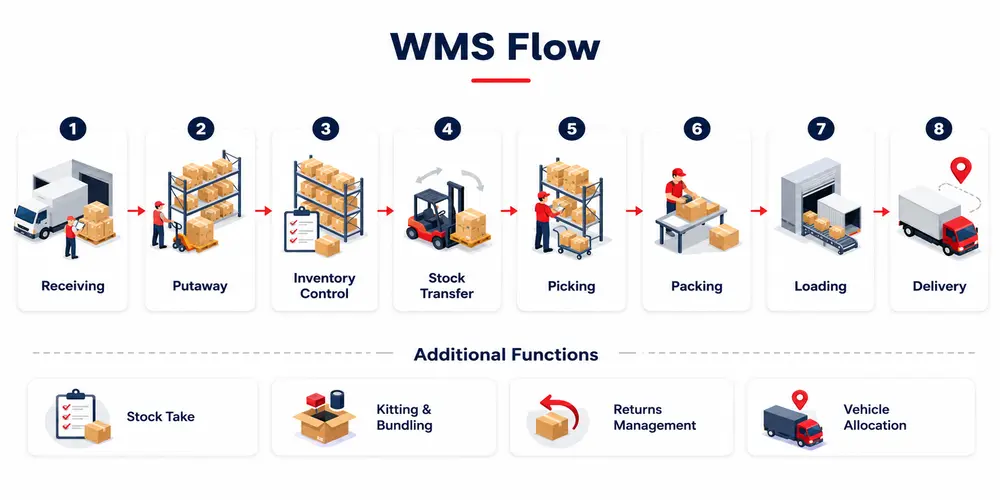
WMS flow from receiving and putaway to picking, packing, loading, and delivery

The WMS flow above shows how warehouse activities can be connected from inbound receiving to outbound delivery. This matters because many warehouse issues happen when each step is handled separately, updated manually, or recorded too late. When these activities are captured in one structured workflow, teams can work with clearer inventory records, fewer fulfilment mistakes, better coordination between locations, and more reliable reporting.

WMS Capability What It Supports Business Value
Stock movement tracking Records where stock comes from, where it is stored, where it moves, and when it leaves the warehouse Helps create more reliable inventory records and makes stock issues easier to trace
Picking and packing control Guides teams on what to pick, where to pick, and how to verify items before dispatch Helps reduce fulfilment mistakes such as wrong items or wrong quantities
Real-time inventory visibility Updates stock information as warehouse activities happen Helps teams make faster warehouse decisions using shared stock information
Multi-location inventory control Gives businesses a clearer view of stock across warehouses, branches, or storage locations Supports better coordination between warehouses, branches, and fulfilment teams
Reporting and audit trail Keeps records of stock movement, user actions, and warehouse transactions Helps management review warehouse performance and spot repeated issues earlier

A WMS records where stock comes from, where it is stored, where it moves, and when it leaves the warehouse. This helps create more reliable inventory records and makes stock issues easier to trace.

A WMS can guide teams on what to pick, where to pick, and how to verify items before dispatch. This helps reduce fulfilment mistakes such as wrong items or wrong quan

A WMS updates stock information as warehouse activities happen. This helps teams make faster warehouse decisions using shared stock information.

A WMS gives businesses a clearer view of stock across warehouses, branches, or storage locations. This supports better coordination between warehouses, branches, and fulfilment teams.

A WMS keeps records of stock movement, user actions, and warehouse transactions. This helps management review warehouse performance and spot repeated issues earlier.

How QubeWMS Supports Growing Warehouse Operations

QubeWMS is designed to help businesses manage warehouse operations with better visibility, smoother stock movement, and stronger process control. These areas are important because warehouse teams do not only need software features. They need a system that can support daily warehouse tasks, reduce repeated checking, improve access to stock information, and help users complete warehouse activities with less confusion.

QubeApps supports businesses with integrated technology solutions for modern operations. With 14+ years of experience, support for 12,000+ businesses, and a presence across 16 countries, QubeApps brings practical experience in helping organisations improve efficiency, coordination, and operational clarity through ICT and software solutions.

For businesses looking for a warehouse management system in Malaysia, QubeWMS can support key warehouse activities such as receiving, delivery, stock movement, returns, inventory visibility, and reporting.

QubeWMS is relevant for businesses that are facing issues such as:

  • Frequent stock discrepancy

  • Inventory inaccuracy

  • Manual warehouse process

  • Slow picking or dispatch

  • Poor visibility across warehouses

  • Difficulty tracking stock movement

  • Manual reporting

  • Growing warehouse complexity

For warehouse teams on the ground, mobile access is also important. A mobile-first WMS can support activities such as receiving, putaway, picking, transfer, inventory checking, and stock take through supported devices such as tablets, rugged devices, or smartphones. When combined with barcode or RFID tracking, warehouse activity can be recorded closer to the point of work instead of waiting for manual updates later.

Instead of treating WMS as a one-size-fits-all solution, QubeApps helps businesses look at their current workflow, business size, number of SKUs, order volume, warehouse locations, and operational complexity. This helps businesses understand whether QubeWMS is suitable for their current stage and future growth.

Warehouse Problem Checkpoint: Are You Facing These Issues?

Use this simple checkpoint to review your warehouse operation.

Checkpoint Question to Ask
Accuracy Do stock records often differ from actual stock?
Speed Are receiving, picking, packing, or dispatch tasks slowing down fulfilment?
Visibility Can management see stock availability without asking staff manually?
Traceability Can the team identify who moved stock, when it moved, and why it changed?
Scalability Can the current process support more SKUs, orders, branches, or warehouses?
  • 1

    Accuracy — Do stock records often differ from actual stock?

  • 2

    Speed — Are receiving, picking, packing, or dispatch tasks slowing down fulfilment?

  • 3

    Visibility — Can management see stock availability without asking staff manually?

  • 4

    Traceability — Can the team identify who moved stock, when it moved, and why it changed?

  • 5
    Scalability — Can the current process support more SKUs, orders, branches, or warehouses?

If several of these questions point to repeated errors, delays, or visibility gaps, your warehouse process may need better system support.

Frequently Asked Questions (FAQ)

Start by checking whether the issue happens occasionally or repeatedly. If the same stock discrepancy, picking error, delayed update, or reporting problem happens across different staff or shifts, the root cause may not be only human error. It may be caused by unclear workflow, too much manual checking, lack of stock visibility, or system limitations. A proper warehouse review should look at people, process, data, and system together before deciding the next step.

A business should start reviewing its manual warehouse process when stock movement becomes harder to control through Excel, paper, WhatsApp, or verbal updates. Common signs include frequent inventory inaccuracy, slow order fulfilment, repeated stock checking, delayed reporting, and difficulty managing multiple warehouses or branches. Manual tracking may still work for simple operations, but it becomes harder to scale when order volume, SKUs, and warehouse complexity increase.

Before implementing a WMS, businesses should review the full warehouse workflow from inbound to outbound. This includes receiving, inspection, putaway, item location control, stock transfer, picking, packing, returns, dispatch, stock adjustment, stock take, reporting, and user access. Reviewing these areas helps identify where errors, delays, or visibility gaps happen before selecting the right system setup.

Yes. A WMS can support multi-warehouse inventory management by giving teams better visibility over stock across different locations. This helps sales, purchasing, warehouse, and management teams see where stock is available, where transfers may be needed, and which location can fulfil orders more efficiently. It is especially useful for businesses that are expanding across branches, warehouses, retail outlets, or distribution points.

No. Warehouse management software is not only for large enterprises, but it should match the business’s operational complexity. A small business with simple stock movement may not need a full WMS immediately. However, SMEs and growing businesses may benefit from WMS when they face repeated warehouse management problems such as stock discrepancy, inventory inaccuracy, manual data entry, poor real-time inventory visibility, and fulfilment delays.

Inventory management focuses on stock quantity, availability, and value, while warehouse management focuses on how stock moves inside the warehouse. This includes receiving, putaway, picking, packing, stock transfer, loading, delivery, stock take, and reporting. A WMS helps connect inventory data with actual warehouse activities so businesses can manage both stock accuracy and warehouse workflow more effectively.

Stock records usually differ from physical stock when warehouse activities are not updated accurately or on time. Common causes include incorrect receiving, misplaced items, unrecorded stock movement, picking mistakes, delayed system updates, manual data entry errors, and lack of regular cycle counting. When this happens repeatedly, the business should review both its warehouse process and system controls.

A WMS improves real-time inventory visibility by recording warehouse activities as they happen. When goods are received, moved, picked, packed, transferred, returned, or dispatched, the system updates stock movement records more consistently. This helps sales, purchasing, warehouse, and management teams work from a shared inventory view instead of relying on manual checking or outdated reports.

Yes. A WMS can work with barcode or RFID tracking to help capture warehouse activities more accurately. Barcode scanning is commonly used for receiving, item verification, picking, packing, transfer, and stock take. RFID can support faster identification and tracking in suitable warehouse environments. The right approach depends on the type of stock, warehouse layout, process complexity, and budget.

Summary

Warehouse problems often become serious when they happen repeatedly. A single stock mismatch or picking mistake may not seem major, but repeated errors can affect fulfilment speed, customer service, purchasing decisions, reporting, and business growth.

If your warehouse is facing stock discrepancy, inventory inaccuracy, manual warehouse process issues, warehouse bottlenecks, or lack of real-time inventory visibility, it may be time to review whether your current process can still support your operation.

A warehouse management system is not about adding software for the sake of it. It is about helping the business work with clearer stock information, faster warehouse decisions, and a more structured way to manage warehouse activities as complexity increases.

If your business is exploring a warehouse management system in Malaysia, QubeApps can help you review your warehouse workflow and understand whether QubeWMS is suitable for your current needs and future growth.

Speak to QubeApps to review your warehouse workflow and identify whether QubeWMS can help improve stock accuracy, fulfilment speed, and operational control.

Published On: June 4, 2026 / Categories: Guide & Tips, Software Solutions /